 Form 5500-EZ is filed annually for one-participant retirement plans, either electronically via EFAST2 or by paper if eligible, and is due the last day of the seventh month after the plan year ends.
Who Must File Form 5500-EZ
You must file Form 5500-EZ for a retirement plan if the plan is a one-participant plan or a foreign plan that is required to file an annual return under section 6058(a).
A one-participant plan means a retirement plan (that is, a defined benefit pension plan or a defined contribution profit-sharing or money purchase pension plan), other than an Employee Stock Ownership Plan (ESOP), which:
- Covers only you (or you and your spouse) and you (or you and your spouse) own the entire business (which may be incorporated or unincorporated); or
- Covers only one or more partners (or partners and their spouses) in a business partnership (treating 2% shareholder of an S corporation, as defined in IRC §1372(b), as a partner); and
- Does not provide benefits for anyone except you (or you and your spouse) or one or more partners (or partners and their spouses)
A foreign plan means a pension plan that is maintained outside the United States primarily for nonresident aliens. A foreign plan is required to file an annual return if the employer who maintains the plan is:
- A domestic employer, or
- A foreign employer with income derived from sources within the United States (including foreign subsidiaries of domestic employers) if contributions to the plan are deducted on its U.S. income tax return
Do not file an annual return for a plan that is a qualified foreign plan within the meaning of section 404A(e) that does not qualify for the treatment provided in section 402(d).
All one-participant plans and all foreign plans should file a return for their final plan year indicating that all assets have been distributed.
Filing Threshold
You must file Form 5500-EZ if your retirement plan qualifies as a one-participant plan, covering only the business owner and possibly their spouse, or one or more partners and their spouses in a partnership and the plan’s total assets exceed $250,000 at the end of the plan year. The filing obligation applies when the aggregate assets of all the one-participant-plans you maintain exceed $250,000 at the end of the plan year. However, if the combined total stays at or below $250,000, you’re exempt from filing for that year.
Even if assets are below $250,000, a final plan year requires filing.
Who Cannot File Form 5500-EZ
- Employee Stock Ownership Plans (ESOPs) are specifically excluded from the one-participant plan definition and cannot use Form 5500-EZ
- Plans that include other employees are not eligible for Form 5500-EZ and must use Form 5500 or 5500-SF instead
- The long-term, part-time employee rules may cause employees of a plan sponsor to lose the eligibility to file as a one-participant plan when employees who work 500 hours for two consecutive years become eligible to participate in the plan
- Since plans that cover employees are covered by ERISA, they must file Form 5500-SF with the DOL
- A former one-participant plan that has an employee that meets the eligibility criteria for the first time must file a Form 5500-SF as an initial year filing. Checking the initial year filing box on Part I of Form 5500-SF prevents correspondence from the DOL, which will otherwise presume that prior Form 5500-SF filings since the plan’s inception dates might be missing
What to File: DB Plans
If you file Form 5500-EZ, you are not required to file schedules or attachments related to Form 5500 with the 2025 Form 5500-EZ. However, you must collect and retain for your records completed Schedule MB (Form 5500), Multiemployer Defined Benefit Plan and Certain Money Purchase Plan Actuarial Information, if applicable, and completed and signed Schedule SB (Form 5500), Single Employer Defined Benefit Plan Actuarial Information, if applicable. Even though you do not have to file the Schedule MB (Form 5500) or Schedule SB (Form 5500) with the 2025 Form 5500-EZ, you are still required to both perform an annual valuation and maintain the funding records associated with plan funding in the same manner as a plan for which the applicable schedule must be filed. The same concept applies to eligible combined plans.
Eligible combined plans: The Pension Protection Act of 2006 established rules for a new type of pension plan, an “eligible combined plan,” effective for plan years beginning after December 31, 2009. An eligible combined plan consists of a defined benefit plan and a defined contribution plan that includes a qualified cash or deferred arrangement under section 401(k). The assets of the two plans are held in a single trust but are clearly identified and allocated between plans. The eligible combined plan design is available only to employers that:
- Employed an average of at least 2, but no more than 500, employees on business days during the calendar year prior to the establishment of the eligible combined plan; and
- Employ at least 2 employees on the first day of the plan year that the plan is established
Because an eligible combined plan includes both a defined benefit plan and a defined contribution plan, the Form 5500-EZ filed for the plan must include all the information that would be required for either a defined benefit plan or a defined contribution plan, if it is otherwise eligible to file Form 5500-EZ.
Retroactively Adopted Plans: Filing Requirements
Retroactively adopted plans do not have to File a Form 5500-EZ for their first year, as permitted by SECURE Act Section 201, but Schedules SB and MB must be prepared for both years. As stated previously, the 2025 Schedule MB (Form 5500) and the 2025 Schedule SB (Form 5500) are available only electronically from the Department of Labor. You can complete the schedules online and print them out for your records. If you are a Form 5500-EZ filer, do not attempt to electronically file the Schedule MB or Schedule SB related to your 2025 Form 5500-EZ filing.
Filing Deadline and Extensions
The form is generally due on the last day of the seventh month after the plan year ends (e.g., July 31 for a calendar-year plan). You can request an extension of up to 2½ months by filing Form 5558 with the IRS. You can rely on the extension for the plan sponsor’s return, if the plan’s year end and the sponsor’s year end are the same, but not beyond the date of the Form 5558 extension. Special extensions may apply for filers affected by disasters or serving in combat zones. If the deadline falls on a weekend or federal holiday, you can file on the next business day.
Filing Methods
Mandatory Electronic Filing: You must file the Form 5500-EZ electronically using the EFAST2 Filing System for plan year beginning on or after January 1, 2025 if you are required to file at least 10 returns of any type with the IRS, including information returns (for example, Forms W-2 and Forms 1099), income tax returns, employment tax returns, and excise tax returns, during the calendar year that includes the first day of the applicable plan year.
If you are required to file a Form 5500-EZ electronically but you do not, you are considered to have not filed the form even if a paper Form 5500-EZ is submitted. See Treasury Regulations section 301.6058-2 (T.D. 9972) for more information on mandatory electronic filing of employee retirement benefit plan returns. On a year-by-year basis, the IRS may waive the requirements to file Form 5500-EZ electronically in cases of undue economic hardship. In general, you should maintain documentation supporting the undue hardship or other applicable reason for not filing electronically.
Paper Filing: If you are not subject to the electronic filing requirement, you may submit a paper Form 5500-EZ to the IRS. Maintain documentation if claiming undue economic hardship for not filing electronically. If you are not subject to the IRS mandatory electronic filing requirement under Treasury Regulations section 301.6058-2, you may elect to file Form 5500-EZ electronically using the EFAST2 filing system.
Information filed on Form 5500-EZ is required to be made available to the public. However, the information for a one-participant plan or a foreign plan, whether filed electronically with EFAST2 or filed on paper, will not be published on the internet.
Copies of submitted filings can be requested by filing Form 4506 with the IRS.
File the paper Form 5500-EZ at the following address:
Department of the Treasury Internal Revenue Service
Ogden, UT 84201-0020
Private delivery services (PDSs)
You can use certain private delivery services designated by the IRS to meet the “timely mailing as timely filing/paying” rule for tax returns and payments. Go to IRS.gov/PDS for the current list of designated services. The PDS can tell you how to get written proof of the mailing date. Private delivery services use the following address:
Internal Revenue Submission Processing Center
1973 Rulon White Blvd.
Ogden, UT 84201
Amended Returns
If you are filing an amended return for a one-participant plan or a foreign plan that previously filed electronically, you must submit the amended return electronically. If you are filing an amended return for a one-participant plan or a foreign plan that was previously filed on a paper Form 5500-EZ, you must submit the amended return to the IRS using the paper Form 5500-EZ. Use the current year forms if you are amending returns originally filed more than 3 years ago. Beginning January 1, 2021, the Form 5500-SF can no longer be used to electronically file one-participant-plan or foreign-plan annual returns. Do not use Form 5500-SF for an amended return of a one-participant plan or a foreign plan, even if you previously filed using Form 5500-SF.
Penalties
Failure to file on time can result in penalties of $250 per day, up to a maximum of $150,000 plus interest. Late filings may qualify for IRS penalty relief programs if you submit a paper Form 5500-EZ and Form 14704, but you are not eligible for the Department of Labor’s Delinquent Filer Voluntary Compliance Program (DFVCP).
Late Filer Penalty Relief Program
The IRS Late Filer Penalty Relief Program for late annual reporting for non-Title I retirement plans (one-participant plans and certain foreign plans) provides administrative relief to plan administrators and plan sponsors from the penalties otherwise applicable under sections 6652(e) and 6692 for failing to timely comply with the annual reporting requirements imposed under sections 6047(e), 6058, and 6059.
Rev. Proc. 2015-32 requires that an applicant must submit a complete paper Form 5500-EZ to the IRS for the delinquent plan year or years.
The IRS delinquent return cannot be filed electronically through EFAST2 System.
IRS Form 14704
IRS Form 14704 is a one-page transmittal schedule used to submit late Form 5500-EZ returns and request fixed-fee penalty relief under Revenue Procedure 2015-32.
Purpose and Use
Form 14704, officially titled “Transmittal Schedule – Form 5500-EZ Delinquent Filer Penalty Relief Program (Revenue Procedure 2015-32),” serves as a cover sheet for paper submissions of delinquent Form 5500-EZ returns. It identifies the plan sponsor, Employer Identification Number (EIN), plan name and number, and lists all delinquent plan years included in the submission. The form also documents the total fee for the IRS to match and post payment, effectively acting as both a table of contents and receipt for the penalty relief program
Eligibility
Form 14704 is intended for:
- One-participant retirement plans covering only the business owner and their spouse
- Certain foreign plans maintained outside the U.S. for non-resident aliens
- Non-ERISA plans; plans subject to Title I of ERISA must use the Department of Labor’s Delinquent Filer Voluntary Compliance Program instead
Plans that have already received a CP 283 penalty notice for a specific year are not eligible for this fixed-fee relief for that year. In such cases, reasonable cause or appeals must be considered.
Fee Structure
The program charges a fixed fee of $500 per delinquent return, capped at $1,500 per plan submission. Payment must be made by check to the United States Treasury and included with the paper submission.
Submission Instructions
- Paper Only: Electronic filings, including EFAST2, are not eligible for this program
- 2015-32, Eligible for Penalty Relief”
- Attach Form 14704 to the oldest delinquent return in the packet
- Mailing: Use the IRS Ogden address listed in the current IRS penalty relief instructions and employ a trackable mailing method. Keep copies for your records
- Marking Delinquent Returns: For years with Box D in Part I of Form 5500-EZ, check the box. For years without Box D, write in red at the top margin: “Delinquent Return Filed under Rev. Proc.”
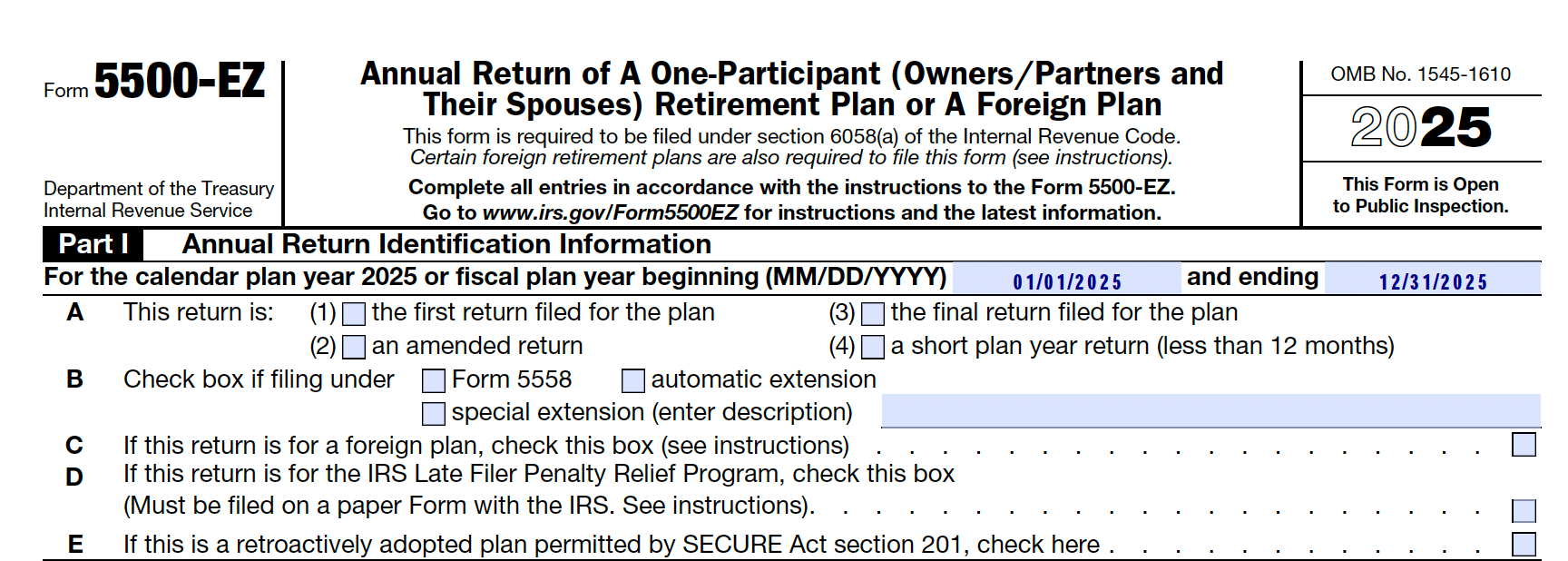
Key Benefits
Using Form 14704 allows eligible plan sponsors to:
- Avoid escalating daily penalties (up to $250 per day, capped at $150,000 per year) for late Form 5500-EZ filings
- Pay a predictable, capped fee instead of potentially large penalties
- Maintain compliance with IRS filing requirements for small or one-participant retirement plans
In summary, Form 14704 is essential for accessing the IRS Delinquent Filer Penalty Relief Program for late Form 5500-EZ submissions, providing a structured, paper-based method to reduce penalties and ensure compliance.
Information Required
Before completing the form, gather:
- Plan name and number (usually 001 for the first plan)
- Plan sponsor’s EIN
- Plan type (Solo 401(k), SEP, defined benefit, profit-sharing, etc.)
- Plan effective date
- Financial information: beginning and ending asset values, contributions (employer and participant), distributions, and rollovers
In Summary
Filing Form 5500-EZ ensures your one-participant retirement plan remains in good standing with the IRS and avoids significant penalties. To ensure an accurate filing:
- Determine your eligibility to file a Form 5500-EZ
- Do all one-participant plans for the same sponsor have $250,000 or more at the end of the year. Final year plans always file regardless of asset level
- Plans with eligible employees, including LTPT employees, must file a Form 5500-SF
- Mark initial Forms 5500-SF for previous 5500-EZ filers as initial forms
- Determine whether you must file electronically or whether you need to file on paper
- Late Filings must be submitted on paper through the IRS Late Filer Penalty Relief Program, if eligible
- Gather all necessary financial information to ensure an accurate filing
- Keep Schedule SB or MB, as applicable, for your records
- Amended filings must be submitted using the same methodology as the original filing
Form 5500-EZ provides the IRS with statistics about plan assets, contributions, and compliance of one-participant retirement plans, such as solo-401(k) plans and owner-only plans. In addition to plan oversight and compliance enforcement, the IRS uses Form 5500-EZ data for broader tax-policy analysis, including understanding the size of tax-deferred retirement assets and estimating the fiscal impact of retirement plan tax benefits. Complying with the filing requirements of IRC Section 6058 is an important responsibility of owner-only retirement plan sponsors.